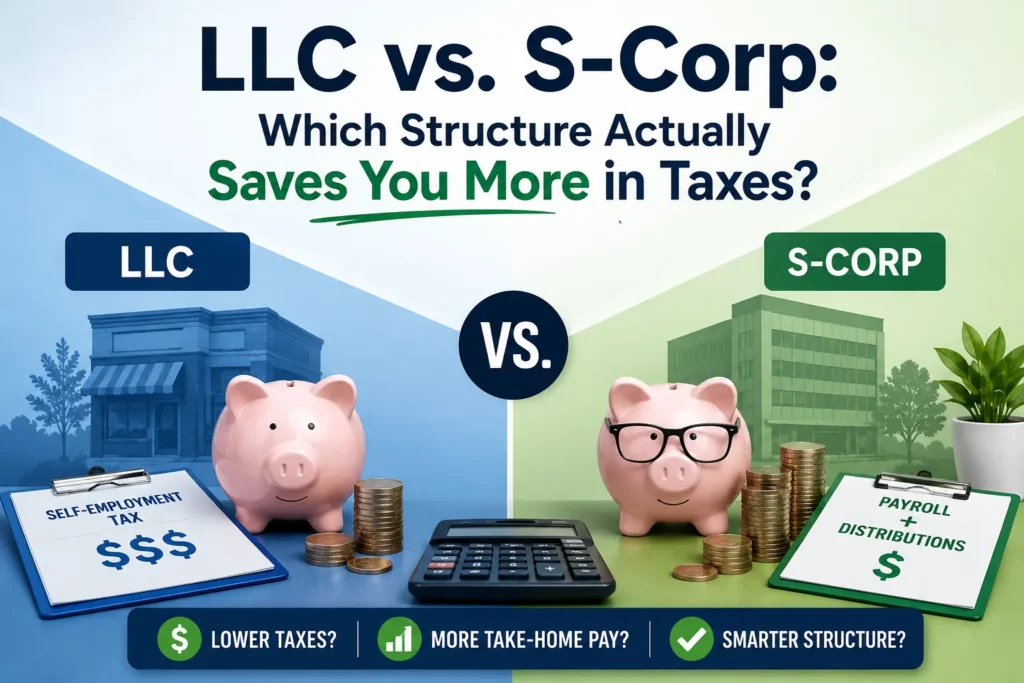
Ask ten business owners which entity type is best and you’ll get ten confident, contradictory answers. The truth is less exciting: the right structure depends on how much you make, how you pay yourself, and how much administrative overhead you’re willing to take on.
Here’s an honest breakdown of when each one actually wins.
The default: a single-member LLC
A single-member LLC is taxed as a sole proprietorship by default. All profit flows to your personal return on Schedule C, and you pay 15.3% self-employment tax on every dollar of net income. It’s simple, cheap, and perfect for new businesses earning under roughly $40,000 in profit.
The downside: above that threshold, self-employment tax becomes the biggest line item on your return.
The upgrade: electing S-corp status
An S-corp isn’t a different entity — it’s a tax election an LLC (or corporation) can make. The advantage is mechanical: you split your income into a “reasonable salary” (subject to payroll taxes) and “distributions” (which are not). On $100,000 of profit with a $60,000 salary, you save roughly 15.3% × $40,000 = $6,120 in self-employment tax every year.
The catch nobody mentions
S-corps come with real costs:
- Payroll service: $40–80/month
- Separate corporate tax return (Form 1120-S): $800–2,000/year
- Reasonable-salary documentation if the IRS asks
- State fees and franchise taxes in places like California
Most Tax Professionals use a rule of thumb: the S-corp election starts paying for itself around $50,000–$60,000 in net profit. Below that, the compliance cost eats the savings.
The bottom line
Stay an LLC while you’re proving the business works. Elect S-corp the year you’re confident profit will clear $60K. And revisit the decision every year — the math changes when your income, state, or business model does.
← Back to blog